

If you’ve ever tracked an Amazon order and seen that familiar “Out for Delivery” update from a blue-and-white USPS truck, you’ve witnessed one of the quiet power partnerships behind modern online shopping.
And this week, that partnership got a crucial update.
Amazon announced Monday that it has reached a new agreement with the U.S. Postal Service—one that preserves roughly 80% of the e-commerce giant’s previous delivery volumes through the mail agency. This comes after months of tension and reports that Amazon was considering slashing its USPS shipments by two-thirds or more.
So what actually happened, and why should you care? Let’s break it down—simply, clearly, and without the corporate jargon.
The Headlines, Explained
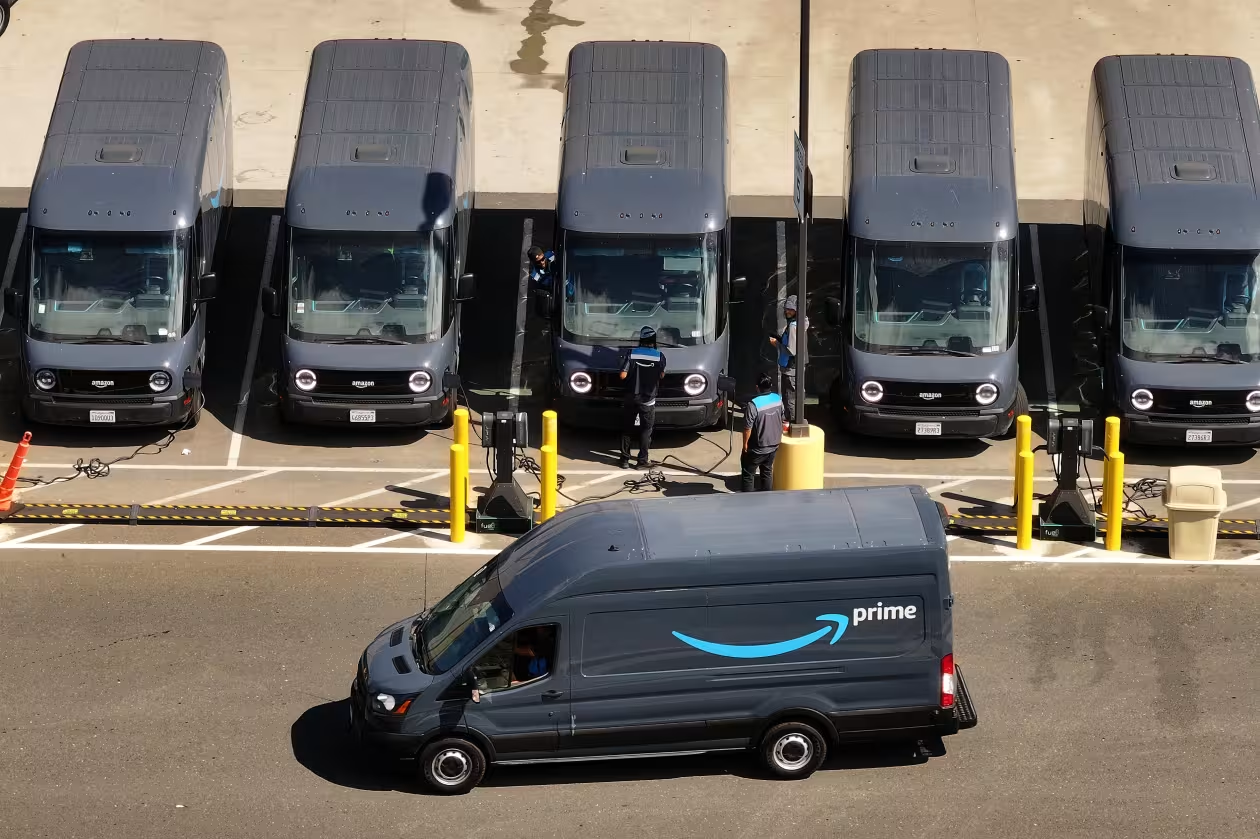
Amazon is the Postal Service’s largest customer, shipping an estimated 1 billion packages annually through USPS. That relationship has been under scrutiny as Amazon continues to build out its own delivery network—warehouses, vans, even drones.
Earlier reports suggested Amazon might dramatically reduce its reliance on USPS, a move that Reuters described as an “existential threat” to the struggling postal agency, which reported a $9 billion loss in its last fiscal year.
But instead of a breakup, we got a compromise: a new deal that keeps most of Amazon’s package flow moving through USPS, particularly for that critical “last mile” delivery to your doorstep.
“We’re pleased to have reached a new agreement with USPS that furthers our longstanding partnership and will let us continue supporting our customers and communities together,” said Terrence Clark, an Amazon spokesperson.
The agreement followed more than a year of negotiations. While final approval from postal regulators is still pending—a standard step—the signal is clear: Amazon and USPS still need each other.
Why This Deal Matters to You
If You Live in a Rural Area
Amazon’s own delivery network is impressive in cities and suburbs. But reaching remote addresses? That’s still USPS territory. The Postal Service delivers to every single address in the United States—no exceptions. By maintaining this partnership, Amazon ensures that customers in less densely populated areas continue to receive reliable, affordable delivery.
If You’re a Small Seller on Amazon
Many third-party sellers rely on USPS for affordable shipping options. A sudden rupture between Amazon and the Postal Service could have disrupted costs and delivery timelines for thousands of small businesses. This agreement brings stability to that ecosystem.
If You Just Want Your Stuff on Time
Let’s be honest: most shoppers don’t care who delivers their package—as long as it arrives when promised. This deal helps maintain that reliability. No sudden service gaps. No unexpected delays. Just your order, showing up when you expect it.
The Bigger Picture: Why Amazon Still Partners with USPS
It’s true: Amazon has invested heavily in its own logistics. The company operates more than 1,000 fulfillment centers across the U.S., runs its own fleet of delivery vans, and is piloting same-day and even two-hour delivery in select markets.
So why keep working with USPS?
Reach. USPS goes everywhere. Amazon’s network is growing fast, but it still can’t match the Postal Service’s universal coverage.
Cost. For lightweight, non-urgent packages, USPS rates remain competitive. It often makes financial sense to use the Postal Service for certain shipments.
Flexibility. During peak seasons like the holidays, USPS provides scalable capacity that helps Amazon handle surges without overbuilding its own infrastructure.
Simplicity. USPS operates under a federal mandate with standardized rules. Navigating a patchwork of private carrier agreements can add complexity Amazon would rather avoid.
This isn’t about nostalgia. It’s about smart strategy: use your own network where it’s strongest, and partner where others have the edge.
What About UPS and FedEx?
Amazon’s relationships with other carriers are evolving too. Last year, UPS announced it would cut its business with Amazon by more than 50%, choosing to focus on higher-margin commercial deliveries. FedEx ended its ground delivery contract with Amazon back in 2020 to pursue its own e-commerce strategy.
The trend? Everyone is recalibrating. Amazon wants more control over its customer experience. Carriers want better profitability. And in the middle: shoppers who just want fast, reliable delivery.
The Amazon-USPS agreement shows that even in a competitive landscape, mutual dependence can still drive smart deals.
What Happens Next?
While the agreement has been announced, postal regulators still need to give final approval—a procedural step, but one worth watching. Beyond that, expect Amazon to continue refining its hybrid delivery model: using its own network for speed in dense markets, and leaning on USPS for reach everywhere else.
For shoppers, the practical takeaway is simple: your Amazon orders should keep arriving reliably, whether they’re handed off to a USPS carrier for the final stretch or delivered entirely by Amazon Logistics.
The Bottom Line
In an era of disruption, it’s easy to assume that bigger companies will always cut ties and go it alone. But the Amazon-USPS deal reminds us that collaboration often beats confrontation—especially when both sides bring unique strengths to the table.
Amazon gets nationwide reach. USPS gets vital revenue. And customers? We get the convenience we’ve come to expect.
That’s a win worth paying attention to.
FAQ Section (Schema-Friendly):
Q: Did Amazon cut its partnership with USPS?
A: No. Amazon and USPS reached a new agreement that preserves approximately 80% of Amazon’s previous delivery volume through the Postal Service, following more than a year of negotiations.
A: No. Amazon and USPS reached a new agreement that preserves approximately 80% of Amazon’s previous delivery volume through the Postal Service, following more than a year of negotiations.
Q: Will this affect my Amazon delivery times?
A: Most customers shouldn’t see major changes. The agreement helps maintain reliable last-mile delivery, especially in rural areas where USPS plays a critical role.
A: Most customers shouldn’t see major changes. The agreement helps maintain reliable last-mile delivery, especially in rural areas where USPS plays a critical role.
Q: Why does Amazon still use USPS if it has its own delivery network?
A: USPS offers unmatched nationwide coverage, cost efficiency for lightweight packages, and flexible capacity during peak seasons—complementing Amazon’s own logistics strengths.
A: USPS offers unmatched nationwide coverage, cost efficiency for lightweight packages, and flexible capacity during peak seasons—complementing Amazon’s own logistics strengths.
Q: Is the deal final?
A: The agreement has been announced, but final approval from postal regulators is still pending, which is a standard step in USPS contractual changes.
A: The agreement has been announced, but final approval from postal regulators is still pending, which is a standard step in USPS contractual changes.
Source: marketwatch
